Switzerland – Tor Alva, a 30-meter-high, four-story 3D-printed tower shaped like a cake, was inaugurated on May 20 in the village of Mulegns, Alps.
The tower, built by the Nova Fundaziun Origen cultural foundation in collaboration with the Swiss Federal Institute of Technology ETH Zurich, aims to “revive” Mulegns – a village with less than 20 inhabitants. According to the project team, this is the tallest 3D-printed tower in the world. Design Boom said that after 5 years in Mulegns, it will be dismantled and rebuilt elsewhere.

Tor Alva, or the White Tower, was built on a building that used to be a blacksmith’s workshop. The tower’s design was intended to resemble a layered cake, honoring the bakers of the region, while blending into the surrounding mountain landscape.
Tor Alva was developed by architect Michael Hansmeyer, professors Walter Kaufmann, Robert Flatt, Benjamin Dillenburger from ETH Zurich, the university’s spin-off company Mesh, and the construction company Zindel United. The structure is built from 3D-printed concrete parts, which are also the load-bearing components. They were printed by ETH Zurich at its Honggerberg facility in five months and then shipped to the village of Mulegns.
Robots build concrete components using additive manufacturing – concrete is built layer by layer and reinforced with steel rings, eliminating the need for molds. The components are joined together without adhesives, using removable screws and prestressing cables to ensure the structure can be easily dismantled and rebuilt elsewhere in the future. The floors are connected by spiral staircases.
“While one robot lays down the concrete layer by layer, a second robot places reinforcing rings into the structure every 20 centimeters. This horizontal reinforcement across the ring is supplemented by vertical steel bars added after printing,” the construction team explains.
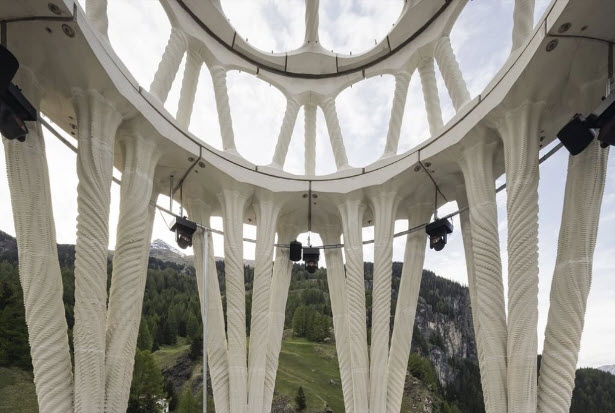
Professor Flatt developed a special fast-setting concrete mixture. Just before the concrete was sprayed from the pressure nozzle, two additives were added to the mixture, which created the water drop-like patterns on the towers.
Architect Hansmeyer told Dezeen that this is the first time this printing method has been used for structural parts, whereas previously it had only been used for decorative details.
“The White Tower is not just an engineering achievement. It inspires the construction industry, promotes sustainable tourism and provides new cultural spaces. It also gives a decaying village a new chance,” concludes Giovanni Netzer, founder of Nova Fundaziun Origen.
From 23 May, Tor Alva will open daily for guided tours, then become a performance venue with a stage located on the dome.