Dr. Ta Viet Dung, Dr. Tran Thi Thu Huong, Dr. Nguyen Khanh Tung
Department of Technology Application and Development, Ministry of Science and Technology
3D printing technology is widely used in industries, rapid prototyping technology, helping businesses convert initiatives and ideas into real products quickly and effectively. Appearing in Vietnam in 2003, from being mainly applied in research, to date 3D printing technology has been present in many fields such as medicine, architecture, fine arts, fashion, mechanics, education… Based on the assessment of the current status of 3D printing technology application in Vietnam, a 3D printing technology map has been built to contribute to the orientation of application and development of this technology in our country.
History of development and application
3D printing technology was born in the late 1980s, also known as “additive manufacturing technology”, has become an important technology trend in the world and is one of the key technologies of the Fourth Industrial Revolution. According to experts, this is also the “key” technology for the future that any business, any manufacturing industry and any country must pay attention to.
Currently, the applications of 3D printing technology are increasingly widespread, penetrating from macro-industrial fields such as aviation and aerospace to basic industries such as medicine, education, construction, architecture, art and fashion. Specifically, in the electronics industry, 3D printers have been used to manufacture complex parts, especially from different materials, and have opened a new trend. In the manufacturing industry, 3D printers are increasingly widely used, thanks to their ability to produce models with complex shapes, quickly create test products on demand… opening up potential advantages in production costs, process improvements and products for suppliers. In the automotive industry, 3D printing is used to produce experimental designs, create prototypes and produce some special parts and assembly tools. People have even applied 3D printing technology to produce complete cars. In medicine, 3D printing technology has been applied to produce biological tissues, anatomical models of human body parts (bones, teeth, artificial ears, etc.). This technology is also used to support testing of new medical methods and technologies, enhance medical research, teaching and training of medical staff. In particular, with 3D printing of biological tissues (Bioprinting), it is expected to be possible to produce human body parts to replace and transplant damaged organs. In education, 3D printing has very practical applications, especially related to science, technology, engineering and math skills. Students can design and produce products in the classroom and have the opportunity to test ideas, learn and work with 3D printers. This method helps increase students’ interest in learning, teamwork, and interaction in the classroom, as well as supporting their creativity and 3D thinking…
Application of 3D printing technology in Vietnam
Continuous innovation has pushed the limits and unlocked the use of 3D printing technology in a wide range of manufacturing applications. These applications are expected to become more popular in the next 5 to 7 years. Vietnam is no exception to this trend. Our country’s growing economy, with a high proportion of industry, is the basis for the development of 3D printing technology.
Appearing in Vietnam since 2003 and mainly applied in research (due to high cost), up to now, this technology has been present in many fields such as medicine, architecture, fine arts, fashion, mechanics, education…
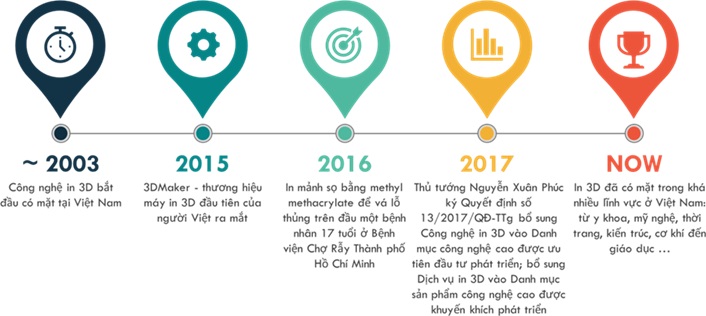
History of 3D printing technology development in Vietnam.
Currently, most 3D printing companies in Vietnam have to import equipment, because the country can only manufacture CNC machines (machines that process 3D images on computers) and low-precision 3D printers, printing small or not too large objects. 3D printing materials are also not self-produced, mainly imported from China. The current status of 3D printing technology in Vietnam is summarized as follows:
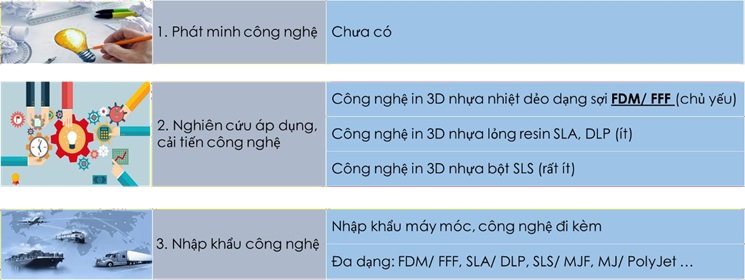
Current status of 3D printing technology in Vietnam.
Surveys and studies at research units and businesses operating in the field of 3D plastic printing in our country show that Fused Deposition Modeling (FDM) and Stereolithography (SLA) along with a few Digital Light Processing (DLP) are commonly used technologies. Of which, FDM is the most popular technology. SLA and DLP are groups of 3D printing technologies that can create highly detailed, sharp and precise object models, but they also require high requirements for machinery, equipment and expensive raw materials. In addition, highly qualified human resources, quality assurance, mastery of technology and equipment as well as design and prototyping skills in research, application, production and development of products from 3D printing technology are still lacking and weak, requiring continuous training and development. Although Selective Laser Sintering (SLS) technology creates the most realistic products with high mechanical strength, it is rarely used, with only 1-2 enterprises (mainly FDI enterprises) investing in this technology.
Currently, a number of research institutes and universities in Vietnam have gradually mastered 3D printing technology in many fields and many different types of raw materials. In particular, the Institute of Mechanics, Hanoi University of Science and Technology is a pioneer in the field of design, processing and manufacturing of PEEK and PMMA biomedical plastics in Vietnam, has researched and applied 3D printing technology to manufacture products for medical and educational purposes (manufacturing bone defect patches, replacement parts for medical implants with higher quality and superior characteristics), and at the same time providing design and 3D printing services for teaching aids for STEM training. Scientists at Ho Chi Minh City University of Technology have researched the application of 3D printing technology in printing metal-mixed plastic… The level of technology and quality of the products are also relatively high, with a size tolerance of about 50 µm (while the smallest tolerance with SLS machines applied in the world is about 10 µm).
Regarding research, design and manufacturing of 3D printers, we only have a few printers on a laboratory scale, and there are no conditions for deploying experimental applications in actual production. Specifically, the Institute of Mechanics, Hanoi University of Science and Technology has manufactured 3D-FDM, 3D-SLA, PEEK, 3D-DLP plastic part printers for applications in medicine and education. The Faculty of Mechanics, Thuyloi University has successfully researched and manufactured 3D printers using FDM technology. Ho Chi Minh City University of Technology has researched and developed multi-color printing techniques and manufactured a multi-color printer line. The 3D Multicolor Printer product with 3 basic colors can be mixed into 16 different colors…
In addition to the achievements, 3D printing is an emerging technology, still on the path of research, completion and development to be able to go hand in hand with and replace traditional manufacturing technologies, and be applied in different industries. Therefore, the products of this technology still reveal disadvantages such as: low mechanical strength, low material density, low production speed and output of products compared to products manufactured by traditional processes. 3D printing service businesses or companies are mainly small in scale (the number of staff is about 20-30 people), the number of machines and equipment is not much, mainly focusing on FDM and SLA technologies. The quality of equipment is good and imported from G7 countries is low. In addition, the level of human resources in this industry is still relatively weak. Universities do not have specialized training programs in 3D printing, and do not provide in-depth training in 3D design. Companies, businesses or research units in the industry have not created a connection between units in the same field, have not given specific directions, development goals or mutual support.
In addition, social awareness of 3D printing is still inadequate. Communication about the power and role of this technology is not enough to help change the mentality of being afraid to apply new things in production, as well as finding ways to produce 3D printers themselves to reduce product costs. Therefore, currently, some domestic units have used 3D printing for many purposes, but the application is mainly experimental.
Potential applications and development roadmap of 3D printing technology in Vietnam
The above analysis shows that the potential for 3D printing applications in a number of domestic manufacturing sectors is quite high. The formation and emergence of high-tech industrial complexes is the basis for the development of domestic 3D printing technology. In recent years, Truong Hai Thaco automobile manufacturing complexes, Vinfast automobile manufacturing complexes, Samsung Vietnam electronics industrial complexes, Vinfast – An Phat Automobile Plastic Components Co., Ltd. (VAPA), fashion footwear companies and large enterprises in the plastics industry have gradually modernized and transformed to join the supply chain of engineering plastic products. Most of these companies are oriented to apply 3D printing in production. Engineering plastics using 3D printing technology to produce automobile, motorbike and electronic components such as ABS, PC, POM, PA, etc.
Research and application of 3D printing technology in printing and manufacturing products in our country in the past nearly 2 decades have initially achieved certain results. It shows that Vietnam has grasped and mastered a number of 3D printing technologies such as FDM, SLA and DLP. On that basis, the 3D printing technology map in Vietnam has been built as follows:
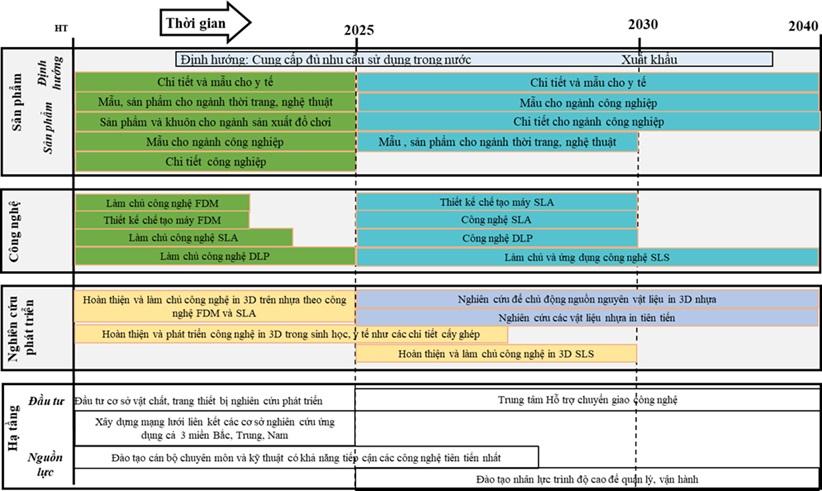
3D printing technology roadmap in Vietnam.
The 3D printing technology map shows that in the short term, it is necessary to continue to perfect and master 3D printing technology based on FDM and SLA technology, mainly designing and manufacturing level 3 and 4 products, and continuing to develop FDM technology into Continuous Filament Fabrication (CFF). In the long term, it will research and develop SLA technology into continuous direct light processing (CDLP) method, moving towards proactively sourcing advanced plastic materials and printing plastic materials for 3D printing.
To effectively deploy 3D printing technology, some key solutions to promote the development of 3D printing applications in the engineering plastics industry have been mentioned in the technology map. Especially solutions on: industry management, development of raw material production for the industry, human resource development, infrastructure development, 3D printing technology transfer, etc.
The 3D printing technology map has shown that 3D printing is one of the new technologies, the trend of the future and will play an important role in production in the 21st century. Therefore, to meet the task of renewing the growth model and economic structure, improving quality, efficiency, developing the country’s economy quickly and sustainably in the new period as well as the requirements of the international integration process, it is necessary to develop policies to encourage research institutions and enterprises to develop 3D printing technology for the engineering plastics industry in the future.