In recent years, 3D printing technology has gone beyond the boundaries of large laboratories and factories, becoming an indispensable part of many areas of life, from medicine, education to industry and even in every family. The remarkable development of 3D printers has opened a new era of production, design and innovation, where any idea, no matter how complex, can be realized quickly and accurately.
From creating complex mechanical parts, precision medical models, to unique personal items, the uses of 3D printers are extremely diverse and rich. However, besides the outstanding benefits, the use of 3D printers also poses a number of challenges, including the issue of power consumption. A 3D printer can operate continuously for hours, even days, making electricity bills a concern for many individual users and small businesses.
This article will take you on a comprehensive journey of exploring the uses of 3D printers in various fields, while providing detailed and practical instructions on how to optimize the power when using 3D printers. The goal is to help you not only exploit the creative potential of this device to the fullest, but also use it in the smartest, most efficient and cost-effective way. Let’s find out!
1. Overview of 3D Printers
Before going into the uses of 3D printers , we need to clearly understand their nature and operating principles.
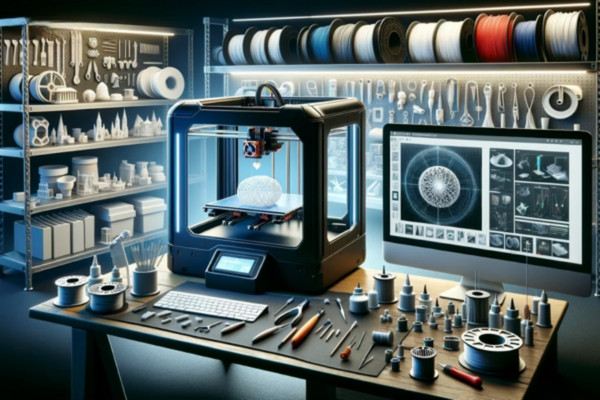
What is a 3D printer? A 3D printer is a device that uses additive manufacturing technology to create three-dimensional objects from a digital model. Instead of cutting away material like traditional methods, 3D printers build objects layer by layer, piling up layers of material on top of each other until the final shape is completed.
How it works: The 3D printing process typically begins with the creation of a 3D model on a computer using CAD software. The model is then “sliced” into thousands of thin layers using specialized software (slicer). This software generates a G-code file containing instructions that tell the printer to move the nozzle and extrude material layer by layer. The printer reads these instructions and builds the object from the bottom up.
Popular 3D printing technologies:
- FDM (Fused Deposition Modeling): Most popular for personal and small business users. The machine extrudes molten plastic filament layer by layer.
- SLA (Stereolithography): Uses UV laser to harden liquid resin layer by layer. Provides high detail, smooth surface.
- DLP (Digital Light Processing): Similar to SLA but uses a digital projector to harden the entire resin layer at once, faster speed.
- SLS (Selective Laser Sintering): Uses laser to melt material powder (plastic, metal) into layers. For durable, sturdy products.
2. Uses of 3D Printers in Life and Industry
The uses of 3D printers are vast and are expanding, touching almost every aspect of modern life.
- In Medicine
The use of 3D printers in medicine is truly revolutionary.
- Creating bone, tooth, body tissue models: Doctors can 3D print anatomically accurate models from a patient’s CT or MRI data. This helps them better plan surgeries, practice before surgery, and even explain them to patients visually.
- Manufacturing of medical instruments, prosthetics, and molds: 3D printers allow the creation of customized medical instruments, prosthetics that fit better and are more comfortable for each patient, or dental molds and orthotics with high precision.
- In Education
The use of 3D printers has made learning more vivid and intuitive than ever.
- Help students be more intuitive in science and engineering subjects: Instead of just looking at 2D images, students can hold and explore 3D models of molecules, cells, geological structures, or complex machine parts.
- Modeling lessons such as mechanics, biology, architecture…: Architecture students can 3D print building models, engineering students can print machine parts for assembly, helping to enhance practical understanding.
- In Industry and Manufacturing
This is the area where the use of 3D printers is most powerful.
- Rapid prototyping: Designers can quickly 3D print prototypes to test designs, functionality, and product improvements before mass production, saving time and money.
- Creating molds, machine components, replacement parts: 3D printers are used to create complex molds, produce specialized machine components, or print replacement parts for old machines that are no longer in production.
- In Fashion and Jewelry Design
The use of 3D printers has brought a breath of fresh air to the fashion industry.
- Make unique fashion accessories: From bracelets, rings, earrings with complex designs that are difficult to make with traditional methods.
- Bracelets, pendants, shoes…: Designers can 3D print prototypes of shoes, handbags, or even parts of clothing.
- In the Interior Industry
- Print interior design models: Help customers and architects visualize the space and interior layout more intuitively before construction.
- Decorations, personalized items: Create unique decorative items such as lamps, vases, figurines, or interior details with a personal touch.
- In Family / Individual
The uses of 3D printers have become more familiar than ever.
- Create toys, home gadgets: Print toys for children, small replacement parts for household items, hangers, storage boxes, cable clips…
- DIY Accessories for Personal Creativity: From electronics projects, robotics, to art models, 3D printers are great tools for those who love to do things with their hands.
3. Advantages of Using 3D Printers
Besides the diverse uses of 3D printers, they also bring many outstanding advantages:
- Optimize design-production time: The process from idea to actual product is significantly shortened, especially during the prototyping stage.
- Product personalization on demand: The ability to create customized, unique products according to the wishes of each individual or customer.
- Save on product testing costs: Instead of having to mass produce for testing, 3D printing helps create prototypes at a much lower cost.
- Increased creativity and flexibility in design: Eliminates many of the limitations of traditional manufacturing methods, allowing the creation of complex shapes, hollow or nested structures.
4. Challenges When Using 3D Printers In Practice
While the uses of 3D printers are vast, there are also some challenges to be aware of:
- Long printing time for large models: Large or highly detailed models can take dozens, even hundreds of hours to print.
- Basic 3D design knowledge required: To create their own models, users need knowledge of 3D design software.
- Continuous power consumption over long periods of time: This is one of the biggest concerns, especially with long print runs.
5. How to Optimize Power When Using a 3D Printer
To minimize electricity costs and use your 3D printer most effectively, you can apply the following measures:
- Choose a 3D Printer with High Performance and Low Power Consumption
- Look for energy-saving certifications: Some manufacturers focus on optimizing the energy efficiency of their printers. Look for certifications or specifications on power consumption.
- Avoid printers of unknown origin or with a capacity that is too large for your needs: Large capacity printers often consume more electricity. Choose a printer with a capacity that is suitable for your printing needs.
- Adjust the Temperature to Suit
Printhead and bed temperature are two significant power consuming factors.
- Depending on the material type (PLA, ABS…), set the appropriate print head and print bed temperature: Each filament type has its own optimal printing temperature. Setting the temperature too high not only wastes electricity but can also cause printing errors (such as sagging, pulling of fibers).
- Avoid excessive heat which wastes electricity: Always refer to the filament manufacturer’s recommendations and only increase the temperature when necessary.
- Turn Off Heat When Not Needed
- Use the “Auto Cool Down” function if available: Some slicing software or printer firmware has a function to automatically reduce the print bed temperature after the first few layers have been printed, or when the print has completed a certain section.
- Turn off or unplug the printer after printing is complete: Make sure to turn the printer off completely when not in use, especially at night or when left unattended.
- Optimal Print Planning
- Group the files to be printed to print at once → save start-up time and electricity: Starting up the printer, warming up the print head and print bed consumes a significant amount of electricity. Instead of printing many times, group the small models together and print them all at once.
- Avoid printing multiple times: This reduces the number of times the machine has to warm up, thereby saving electricity.
- Periodic Machine Maintenance
- Make sure the machine runs smoothly, don’t overload it: A well-maintained machine will run more efficiently and consume less electricity.
- Clean the print head and motor to avoid energy-consuming damage: Dust and plastic residue can increase friction and make the parts work harder, leading to higher power consumption.
6. Energy-Saving 3D Printer Models Suitable for Individuals and Small Businesses
With the goal of saving electricity and good performance, here are some 3D printer models worth considering:
- Anycubic Kobra Neo:
- Pros: Good balance between performance, ease of use and power consumption. Features automatic bed leveling, which reduces preparation time and ensures successful prints.
- Suitable for: Individuals and small businesses who want a machine that is reliable, easy to use and not too power hungry.
- Creality Ender 3 V3 SE:
- Pros: An upgraded version of the popular Ender 3 series, retaining its affordable price and large community, while significantly improving ease of use and power efficiency.
- Suitable for: Beginners, students or anyone who wants a basic, energy-efficient and customizable machine.
- Prusa Mini:
- Pros: Despite its higher price, the Prusa Mini is known for its consistent print quality, high reliability and good automation capabilities. It is designed to operate efficiently and save energy, especially with long print runs.
- Suitable for: Users who prioritize quality and stability, are willing to invest for the best 3D printing experience and save electricity in the long run.
7. Conclusion
Through this article, we have explored in depth the uses of 3D printers in countless fields, from medicine, education, industry to fashion and personal life. Clearly, 3D printers are not just a simple tool but also a symbol of innovation, creativity, and the ability to turn the boldest ideas into reality.
The usefulness of 3D printers is undeniable and their role in the future of manufacturing and innovation is sure to grow. However, to fully exploit the potential of this device, smart use and energy saving are essential. By choosing the right printer, adjusting printing parameters appropriately, planning printing scientifically and maintaining the machine regularly, you can not only reduce costs but also contribute to sustainable energy use.
Come to SMart3D and boldly invest in a 3D printer. You will surely feel satisfied with what you can create, while contributing to a greener, more efficient technological future!